Virtual Bedside Clinics: A Novel Approach to Education and Learning
Written by Yamini Joshi
Published 27th October 2022
A pilot study by Dr. Ramesh Kekunnaya and others from the Child Sight Institute, LVPEI, evaluates ‘virtual bedside teaching’ as an effective method to provide quality and impactful training. The paper discusses the positive results of a survey administered to different cadres who attended virtual bedside clinic sessions and highlights the potential of this method.
Bedside teaching is an important aspect of medical training. It focusses on improving the skills of medical professionals in tasks like history-taking, patient examination, and bedside manner. An experienced practitioner acts as a role model gives advice on evaluating the presenting condition and demonstrates diagnostic insights. The advice can include courtesies extended to the patient. But with advances in diagnostic testing and an increasing dependence on technology, the emphasis on bedside teaching is declining across the medical education sector.
The COVID-19 pandemic has exacerbated this situation. The pandemic led to strict social distancing protocols across hospitals. Medical education became one of the many ‘silent casualties,’ with many noting the lost opportunity to train under the direct supervision of experts. Yet, this crisis has also triggered innovative solutions in this space. The spotlight is now on ways of teaching that move beyond convention and are set up for the post-COVID era.
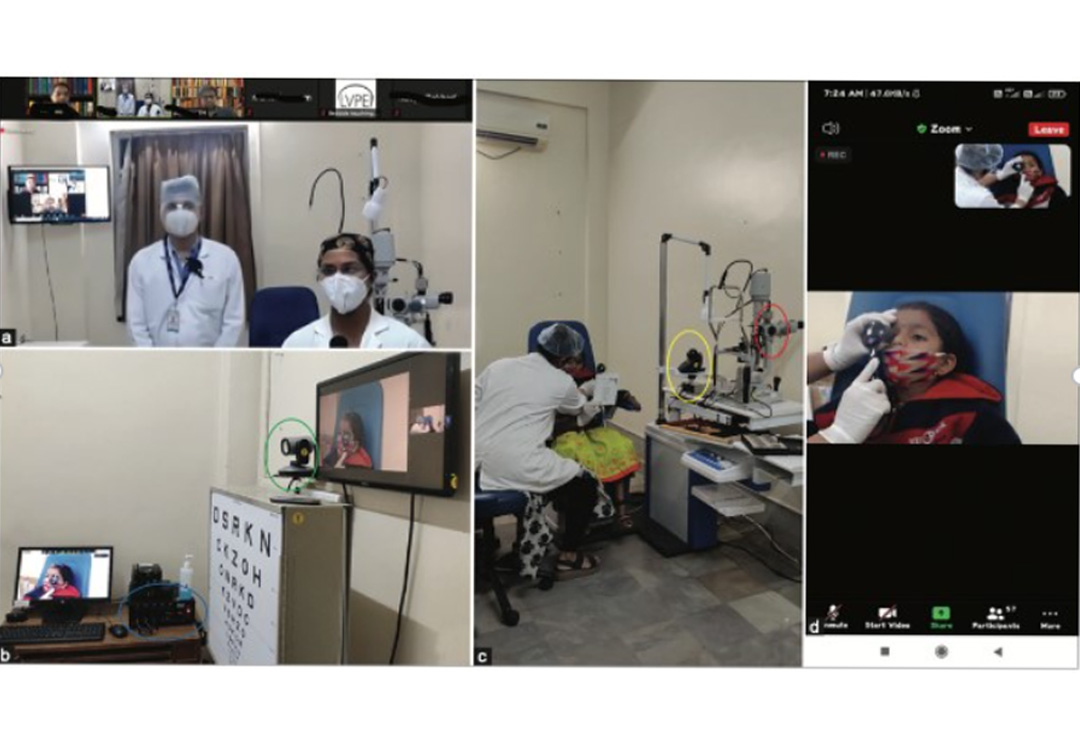
A recent paper in the Indian Journal of Ophthalmology Dr. Ramesh Kekunnaya and his colleagues reports on one such innovation: ‘virtual’ bedside clinics. Their study ran five virtual pediatric ophthalmology and strabismus clinics and evaluated their effectiveness through a participant feedback survey. The virtual bedside clinics were live streamed to pre-registered participants across the world with a bedside examination set-up that comprised a moderator, a trainee-examiner, a patient, and an expert. The video-stream included pre-recorded clinical findings and slides.
2058 participants registered for these virtual clinics, and 938 (45.57%) attended the five sessions. Most of the attendees were ophthalmologists (including residents and fellows), and 287 (~30%) responded to the online survey. Over 95% reported that the virtual bedside teaching was equally effective or better, compared to conventional bedside teaching in the five themes measured (physical examination, clinical knowledge, clinical reasoning, and procedural and communication skills). The respondents favorably compared the hybrid mode of presentation and discussion to physical bedside clinics. The sessions also included courteous interactions with the patient. The study marries the advantages of virtual participation with the intimacy and holistic approach of a bedside clinic. It highlights a novel and interesting way forward for this important training technique.
‘A virtual beside clinic is an effective clinical teaching tool that can be adopted by all subspecialties. Through this, we can train many students who don’t have access to these kinds of conventional bedside teaching sessions. Inconvenience to the patient is also very minimal in these settings,’ says Dr Ramesh Kekunnaya, the lead author of this paper, and Director of the Child Sight Institute at L V Prasad Eye Institute.
Citation
Kekunnaya R, Deshmukh AV, Sheth J, Chattannavar G, Sachadeva V. Virtual bedside clinics in pediatric ophthalmology and strabismus – An innovation in education and learning. Indian J Ophthalmol. 2022 Aug;70(8):3129-3133. doi: 10.4103/ijo.IJO_357_22. PMID: 35918987.
Photo credit: Fig. 1 Setup of the live virtual bedside clinic by Kekunnaya et al.