Host Defense Peptide to tackle Microbial Resistance
Written by Yamini Joshi
Published 26th August 2022
A study by Sanhita Roy and her colleagues from L V Prasad Eye Institute, Birla Institute of Technology & Science-Pilani, and Northwestern University Feinberg School of Medicine, USA investigates the expression of S100A12 (calgranulin C, an antimicrobial peptide) in corneal tissues, its effects on a mouse model, and explores the potential role of S100A12 as an intervention to tackle Pseudomonas aeruginosa keratitis.
Pseudomonas aeruginosa is a gram-negative, opportunistic human pathogen that is resistant to multiple antibiotics. It causes 8-21% of all keratitis in South India. The World Health Organization (WHO) has listed P. aeruginosa as a “priority pathogen”—bacteria that poses the greatest threat to human health—and urges development of urgent, alternative therapeutic approaches. This bacterium has a formidable repertoire of genetic tools to infect and overcome immune defenses. It deploys a range of virulence factors, and it can subvert and manipulate the host cell’s signaling and response mechanisms. P. aeruginosa produces pyoverdine, a key virulence factor that plays a major role in its ability to flood a cell with toxins. The bacterium evades antibiotics with a protective biofilm and by running several ‘efflux pumps’ that help it remove antibiotics from its system.
Antimicrobial peptides (AMPs), short chains of amino acids that modulate and participate in the immune response to microbes, are a promising new therapeutic approach to drug-resistant bacteria. They are effective antimicrobial agents that also help in wound-healing. AMPs are produced by a range of human cells, including the corneal epithelium. In a 2018 paper, the authors found that a P. aeruginosa infection of the cornea induces several AMPs in response, including S100A12, a calgranulin protein found abundantly in the immune system’s neutrophils and macrophages. However, the bacterium effectively suppresses AMP expression by sabotaging the early immune response. By adding recombinant AMPs back into the equation, it may be possible to fight back the infection.
A new paper by Sanhita Roy and others in Microbial Pathogenesis investigates S100A12’s effectiveness against P. aeruginosa. The study tested this calgranulin protein in vitro and in a mouse model of corneal infection. It reports significant inhibited growth in vitro and attenuated infection in the mice, along with a decrease in corneal opacity when exposed to the protein. S100A12 also downregulates a number of genes in the bacterium thereby inhibiting its ability to form biofilm or produce the virulence factors that are so effective in its success.
A crucial aspect of this paper is its use of transcriptome analysis to note changes in gene expression of P. aeruginosa. The transcriptome data establishes the downregulation of genes involved in the bacteria’s pyoverdine pathways when it is exposed to S100A12. The protein also reduces P. aeruginosa’s ability to manage oxidative stress—this ability is key to AMPs’ success against bacteria and has been reported in other studies. Finally, the analysis also notes the reduced expression of the manganese efflux pump, key to P. aeruginosa’s antibiotic resistance. Used together with antibiotics, the S100A12 AMP has the potential to play a critical role in humanity’s next generation therapeutics against bacterial infections, including of the cornea.
‘The interesting finding is that S100A12 not only inhibits the growth of Pseudomonas but affects a repertoire of bacterial genes involved in causing virulence to the host cells. The fact that it is a host defense peptide secreted by corneal epithelium, makes it a more interesting therapeutic alternative to be explored,’ says Dr Sanhita Roy, the corresponding author of this paper and Scientist at the Biochemistry Laboratory, LVPEI.
Citation
Mishra P, Ch S, Hong SJ, Biswas S, Roy S. Antimicrobial peptide S100A12 (calgranulin C) inhibits growth, biofilm formation, pyoverdine secretion and suppresses type VI secretion system in Pseudomonas aeruginosa. Microb Pathog. 2022 Jun 23;169:105654. doi: 10.1016/j.micpath.2022.105654. Epub ahead of print. PMID: 35753599.
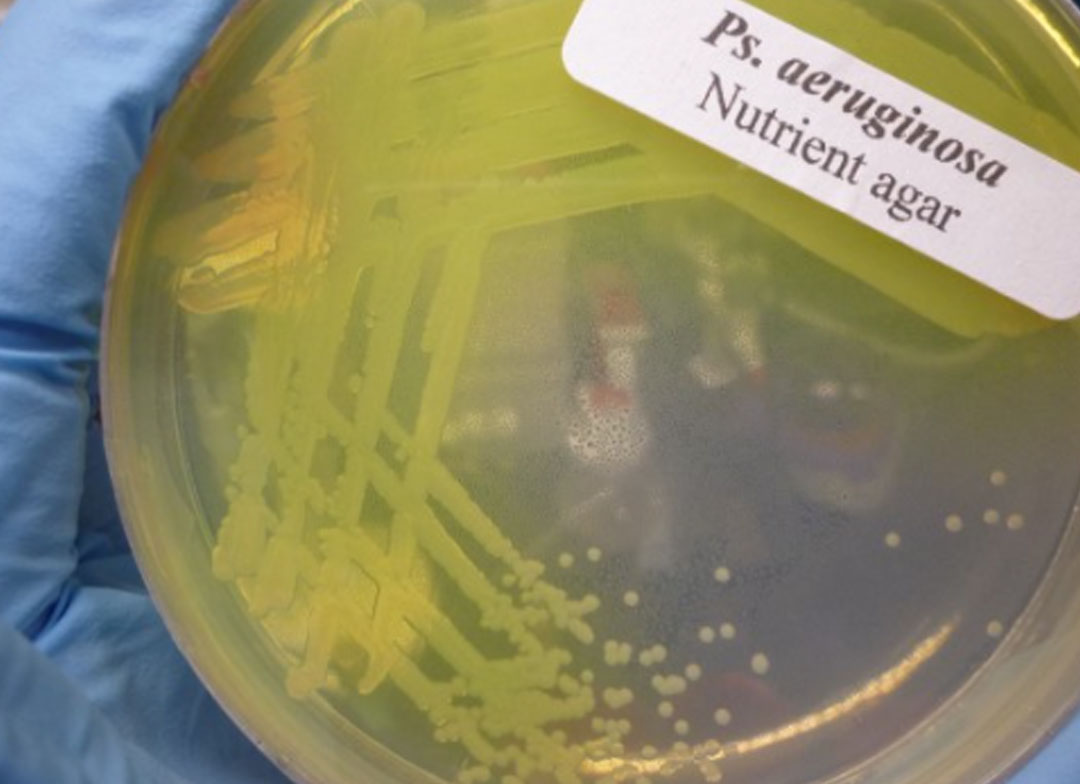
Photo credit: A culture dish with Pseudomonas, photo by Sun14916 – Own work, CC BY-SA 3.0.